
I recently stumbled upon an essay about the differences between fantasy and sci-fi that, in my estimation, came quite close to the truth. I grant that, while some shadowy algorithm undoubtedly slid this essay into my path, circumstances were not such as if I had not wandered into the right part of town to be vulnerable to this maneuver. All that is to say this is a topic in which I am somewhat interested and, true to form, therefore one about which I am strongly opinionated. The truest part of Mr. Stumme’s assessment is that “everyone’s got an answer” to the question of what most fundamentally distinguishes the two genres. I’ve got plenty of hats already thrown into plenty of rings as it is, and I do not see why I should make an exception in this case.
The second truest part was his description of the speculative nature of science fiction as opposed to the dissective nature of fantasy, but I think his view on both falls short of their deeper natures. Mr. Stumme’s assessment seems to be that fantasy is about the self while sci-fi is about the world, but this misses both the true breadth of fantasy and the true truth of fiction in general.
The real difference between fantasy and science fiction seems to be that fantasy is concerned with the real world and science fiction is not. To be more precise, or pedantic, science fiction is only pertinent to reality by proxy of hypothetical realities. Science fiction describes the potential, fantasy the actual.
I have attempted in the past to offer at least half of this assessment, and, in view of the state of culture, I sense that this juxtaposition goes somewhat against the grain of the popular imagination at present. As I’ve argued, the dominant theory of fantasy today permits sci-fi to annex the essence of fantasy, placing the latter on a shoddy reservation of mere aesthetic. From this confinement emerges a pervasive assumption that medieval trappings define fantasy and distinguish it from sci-fi. Yet, even this superficial provision is often tarnished by an evolving departure from historic medievalism into the far more imaginative and internally-referential design territory of something like World of Warcraft, a mess of spiked, flanged, absurdly tangled spirals of visual cotton candy — colorful, exaggerated and detached by an excess of degrees from anything that ever really existed.
Now, World of Warcraft certainly has a look, even a cool one, but at some point one has to be able to admit that there is nothing very “medieval” about it. The characters wear pauldrons and carry warhammers, sure, but the visual language reads more like Spawn than like William the Conqueror. It riffs on medieval elements without committing to folkish simplicity.
A lot of fantasy exists in this comic-book-meets-metal-album aesthetic as a reflection of its decidedly unreal substance. The fact that the “medieval” idiosyncracies can often be swapped for “futuristic” ones betrays the identical framework underneath. Warcraft begot Starcraft. Warhammer travelled to the year 40,000 and changed even less than the previous example. As someone who doesn’t know much about Warhammer, I can say confidently that the only difference between most 40k and Age of Sigmar character designs to my untrained eye is the presence or absence of a firearm. (There is much to be said here as well that both of these examples being games represents how games, especially videogames, which are fundamentally algorithmic, mathematical systems, shape our perception of the reality they simulate.)
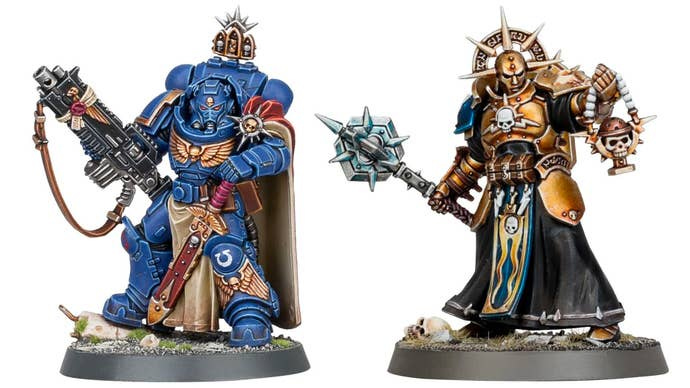
A little game we outsiders call, “Which one’s the spaceman?”
I am aware that this is a low-hanging example because these two are designed to share a great deal of visual language, but this exaggerated similarity helps isolate the fact of the simplicity in transitioning between the two. The difference between fantasy and sci-fi in this paradigm is less than aesthetic, it’s only one part thereof: technological advancement. This is probably because we modern people love our technology. We measure progress by it, mark history by it, even gauge national wealth by it. It isn’t even technology per se at issue in this example, because the visual style of so much pop fantasy entails armors and weapons and buildings that simply are not possible with pre-industrial means of manufacture. Again, at some point there is nothing about this aesthetic that could be called “medieval” in any meaningful sense. What does the word “medieval” mean if it doesn’t even refer to a historic time, place, or even movement? It is a medievalism transfigured and mangled by the filter of modernity.
This is not to say in the slightest that overwrought, extreme designs like this cannot look downright slick. I remember fondly as a little kid, during that quintessential boyish obsession with dragons, being awestruck by the promotional art for World of Warcraft’s expansion Cataclysm on posters and standees at GameStop. But, if you took that GameStop standee to thirteenth-century Bavaria and somehow overcame the ensuing confusion to poll local peasants on their opinion of the piece, how many of them would even recognize that it was supposed to depict a dragon? Medieval dragons were as likely to look like tiger-sized chickens as whatever swirling mass of pixelized fangs and metal adorned the game stores of my childhood.
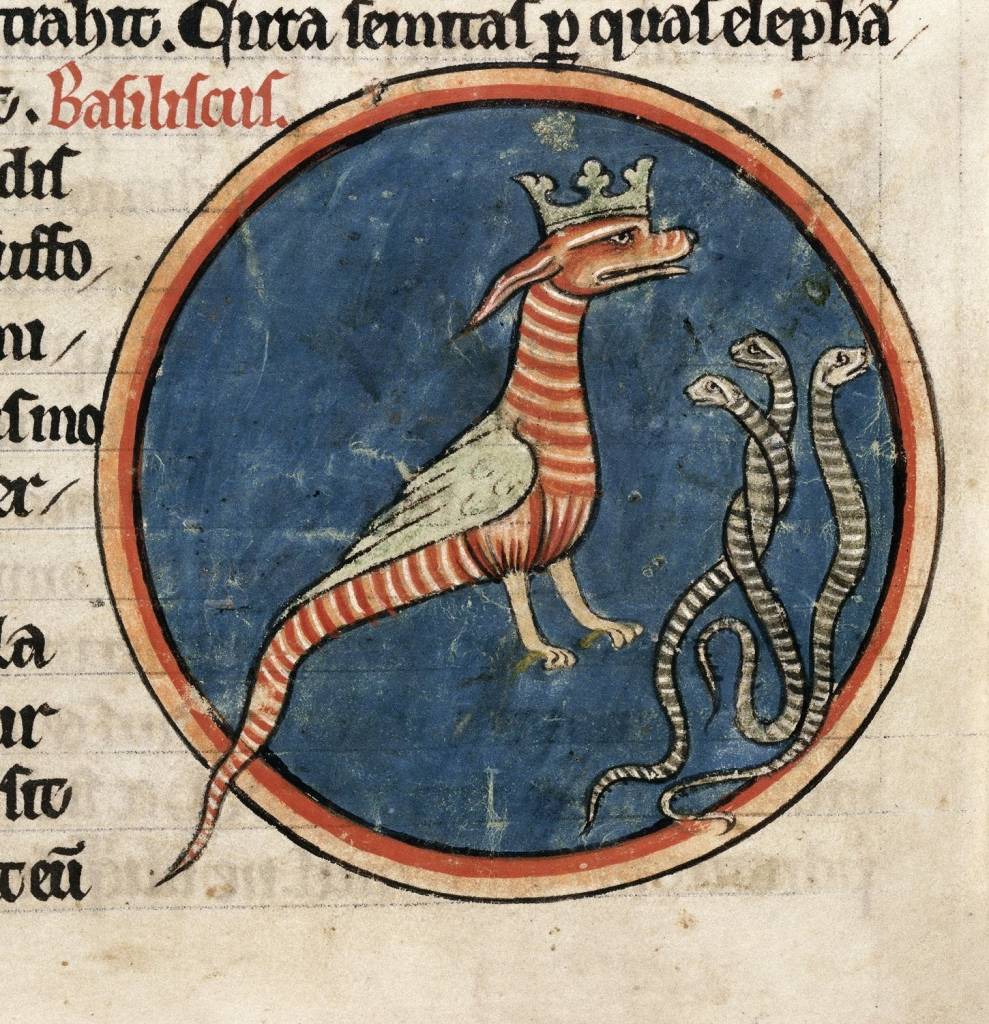
This difference penetrates beneath the superficial. Consider that whereas medieval and ancient dragons were often chimeric, constructed from discrete elements of real animals, the dragon of modern design is much more self-referential, adhering to familiar patterns ingrained in culture while far more organically libertine. They do not look like any real animal so much as an alien life form, a distinctly imagined, hypothetical species. Dragons are real and, in a mythical way, aliens are, too, but as far as anyone knows no particular alien life form is real. The archetypal space alien, in the Western mind at least, is embodied in the familiar green man with a bulbous head and vacuous eyes, but none of the menagerie of extraterrestrial creatures imagined in sci-fi, from Farengi to Sangheeli (to the endless sea of Spore’s user-generated abominations), have ever been found in the actual Milky Way except in the dancing phosphors and liquid crystals of earthling screens.
Bringing this aside about aesthetics to bear upon the point of a shared framework, the stuff of this modern kind of fantasy aesthetically resembles sci-fi more than ‘classical fantasy,’ let’s say, because its underlying structure is aimed at describing hypothetical worlds distinct from our own, filled with their own unique creatures and histories. It’s a helium balloon unmoored from reality and sailing into the stratosphere of the imaginary, often without ever coming back down, rather drifting pointlessly into space.
Last time I wrote on this topic, I made the terrific blunder of using Tolkien as an example rather than C.S. Lewis, but my humiliation on the lore of Middle-Earth brought me to appreciate more that Tolkien is a sort of bridge between modern and classical fantasy. He treated the setting of his fiction as a concrete world unto itself, a “universe” in current parlance, yet also wrought this “universe” from premodern materials. His constructed languages are a great example, utterly fictitious yet seeded by the real, historic languages Tolkien knew. He, like Elrond, who is apparently only half-elf, walks in two worlds, one foot in the modern and one in the antique.
But enough about Tolkien. The gloves are off now. C.S. Lewis’ fantasy stories have a more typically antique quality to them than Tolkien’s, probably owing to his expertise in the medieval (which, commingled with an eschewal of Roman Catholicism, probably paved the way for a more mystical disposition). This fairy-tale ethos is obvious at a glance in the more brazenly allegorical nature of The Chronicles of Narnia. Lewis is a little more Aesop and a little less Homer. In Voyage of the Dawn Treader, an anthropomorphic star explains to Eustace that stars are the same kind of angelic beings in his world, that is, our world, as they are in Narnia. The thirteenth-century Bavarian commoners from earlier would be nodding along, no doubt. In the strongest example, Aslan outright explains to the children, practically staring through the literary fourth wall to address the reader, that he is real, as real in the “real world” as in Narnia.
Still, Lewis cannot help being a modern man. Narnia is also a sort of world apart, and his “Wood between the Worlds” passingly resembles the multiversal motif of science fiction. But Narnia is not an alternate reality for Lewis, just an alternate view on the same reality. They are not parallel dimensions, but intersecting ones. Narnia is the angle from which the enchanted is visible, the perspective that peers around and behind the veil of the material. Narnia is a place children must go because what they find there will come back with them. The wardrobe is not a wormhole or teleporter, it’s an ordinary item imbued with magic. It’s a piece of the supernatural impinging on the fabric of the natural.
I think this is a large part of why the movie adaptations of Narnia petered out, no pun intended, where Lord of the Rings succeeded. Even Harry Potter has his brand-building “wizarding world,” whatever that means. The economic apex predator of second millennium media so far has proven to be the infamous “cinematic universe.” But Lewis didn’t set out to build a universe. He set out to explain ours. Even if Greta Gerwig understands that, I’m even less optimistic that Netflix does. Or cares. Reality is a lot less marketable than dregs from the fathomless cistern of imagined alternatives, otherwise the saying would be, “Morality sells.”
Relatedly, this is why worldbuilding is the hobgoblin that dogs modern fantasy. Where the scientistic impulse yearns to define a work of fantasy by a speculative setting, the consumerist impulse catalyzes obsession. Together, this potent mix is what sends so many popular works twirling away from reality and into the pitch-blackness of useless, valueless vacuity. Fantasy centered around “building a world” is often necessarily distracted and even prevented from describing the real one.
Ultimately, what the essay that sparked this train of thought misses, in my opinion, is that fantasy as a whole is only about the human psyche insofar as the human psyche is a component of the real world, because fixation on reality is, perhaps counterintuitively, the definitive essence of fantasy. Fantasy — indeed, proper fantasy — does not ask what would happen if a man met a real life dragon, it assumes that men meet real life dragons all the time and asserts what they have done or what good men must do when, not if, these encounters bubble up. Science fiction does not concern itself with what to do about some universal trope of space alien arrival or what a laser gun might be manifest as in the workings of history and the day-to-day, but instead asks what some world full of aliens and laser guns might look like were it to be real. Science fiction leaps from earth to worlds beyond, fantasy delves down into the things between the earth and the invisible.
It’s not my intent to dunk on Mr. Stumme or suggest that he’s a dummy or anything. He gets a lot closer to the truth of the matter than many as far as I can tell. My concern, though, is that his thesis is suffocated by something like Rousseau’s notion of the internal world. Good fantasy certainly helps one navigate himself, but it should also help him navigate the world around him. An internal/external distinction seems inadequate, where a potential/actual criterion seems to me much more robust.
I wouldn’t suggest that the fantasy/sci-fi distinction is some unassailable, airtight fixture of art, either. They are categories built by people to help said people understand how to relate to the material they describe. In that light, my main worry is that most fiction today is treated by the people who absorb it as science fiction. The machinations of scientism on the scale of civilization introduces poignant, devastating myopia. The antisupernatural, materialist animus of the modernized West so often blinds us to broad swathes of truth. A literature of enchanted, classical fantasy must coexist with readers willing to look at it the right way. Donkeys can’t eat meat, wolves can’t eat straw, and materialists can’t read fantasy. Fantasy cannot attain to its unique domain of truth if it forgoes myth, and it cannot achieve myth if it is too timid to be a humble fairytale.
My point for Mr. Stumme is that fantasy has the potential to speak to so much more than just a psychologized vision of humanity. I would contend that that approach is not unrelated to the relegation of fantasy to a sub-genre of sci-fi in that both emerge from very modernist impositions on the subject, even consigning the realm of truth to the purview of science. A man is more than his mind, and the world is more than man. Good myths don’t just help a man understand his own unique “self,” they teach him what a human self is in the scheme of the cosmos. If we desire for fantasy to spread its wings and do its job, we have to disassemble the cages of modernity that imprison it with its pretended counterpart.
He telleth the number of the stars; he calleth them all by their names. — Psalm 147:4 (KJV)


 Being Kindled
Leave a reply to J.A. Klumpenhower Cancel reply