
“You are special in all this emptiness.” — Victor Glover, from aboard Artemis II
The recent launch of Artemis II caught me off guard, as I’m sure it did many who only cursorily follow the news. I had heard some time ago that another manned lunar mission was to take place, but as time passed with no further information crossing my path, the event was buried in dormant memory until the day of the launch brought it soaring back to the front. What surprised me more than the rocket launch was how exciting I found it — namely the breathtaking photographs which have arrived with the internet era’s astonishing absence of delay.
Nowadays, most scientific news tends to glance off my attention with little impact. Headlines abound reporting everything from the most inanely infinitesimal discoveries of remote importance and exorbitant cost to the depraved and dismal machinations of greed and hubris. Mindless and soulless are often the only two varieties in which popular scientific news is found. And when so many immediate problems plague the world, cynicism toward adventures far away from the earth becomes effortless. As is so often the case, though, no matter its robustness in rational terms, this cynicism is burst like a bubble by the piercing appearance of beauty.
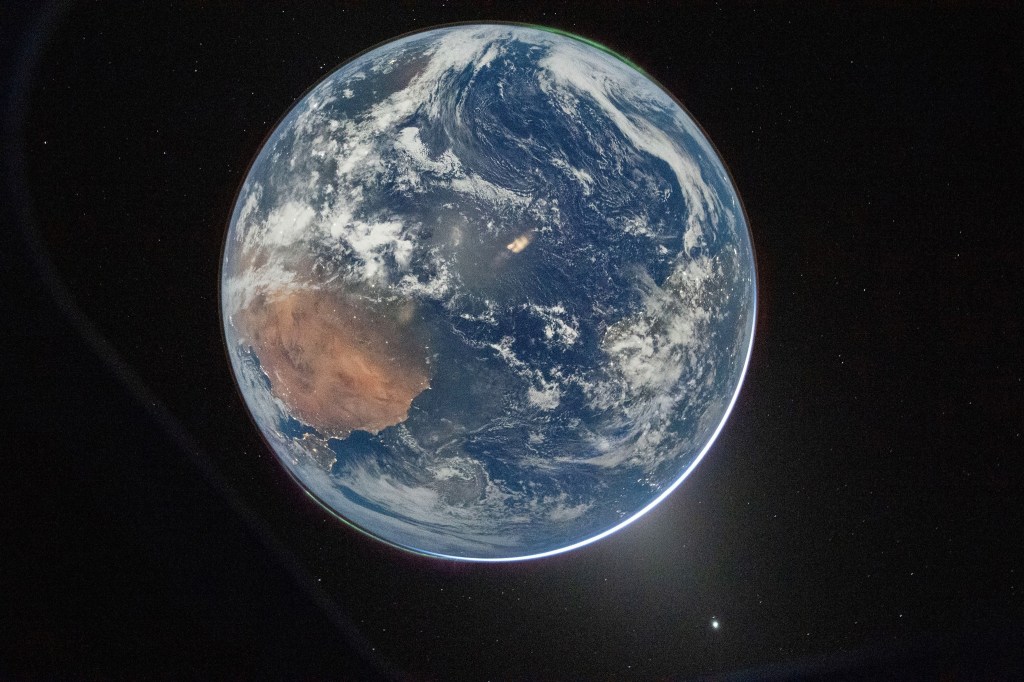
There she hangs, gracefully floating on nothing, a perfect, facetless blue gem set in ebon velvet, crowned and shod with green sky-fire, burnished with sunlight and arrayed in argent threads of cloud dancing like so many strands of silken hair wafted by the cosmic tide across her azure face. And beneath the veil of her skies, the ancient, immovable barrier between the waters above and below, the children of Adam and Eve are bustling about, illuminating the continents with garlands of light all these eons later. Even in a photograph, the scene is awful and wonderful. To this day, the engines of science in all their fiery and thundering power have yet to produce evidence of life, love, grief, joy, music — or of eyes that can wonder at themselves in the mirror of the cosmos — originating from outside the confines of that glistening blue circle.
The powerful emotional effect of seeing our world from the heights of the firmament has been called the “overview effect.” The Earth is already too big to comprehend, too full of variety, of sights and sounds and stories, and yet to see it rendered so small to the eye, contained within so narrow a frame, adds a startling perspective rarely encountered elsewhere. To some, the moral of the overview effect is mankind’s insignificance. The view afforded by space travel constitutes a stern, cosmic finger-wag against the hubris of anthropocentricity. All mankind and all they’ve ever known is a thin film of organic dust on an insignificant blue mote arbitrarily wheeling through the endless dark. But what remains remarkable about that blue mote, Carl Sagan’s “pale blue dot,” is that there is no other dot so full of remarks.
Far from answering humanity’s oldest questions, the image of Earth from space seems to merely to repeat them, insistently drumming them out louder than ever. If that dot is so meaningless, why does it exist? To say there is no reason for its existence is to obfuscate rather than to answer, and to say there is no answer is to ignore the possibility of the question. For that matter, why does this dot seem to be the only dot full of creatures wondering why it exists?
Sagan, after the characteristic fashion of modernity, in his assessment of the “dot” seemed to make the mistake of imagining himself as other than an observer, as if pure reason could issue from his lips, disembodied, uninhibited by perspective. So many modern people wonder why there has been no life found on other planets as though they know why there is life on this one. The genetic fallacy runs rampant, and the modern person clings to the “how’s” that science provides as if they were “why’s.” Many think humanity has found answers because we’ve looked down on the earth, but these timeless questions were often raised by our ancestors rather looking up at the stars.
The Psalmist was no less awestruck than the scientist, and yet he proved that the gentler grip of faith apprehends a certainty within the wonder that eludes scientific rationality. Similarly inspired, he muses, “When I consider thy heavens, the work of thy fingers, the moon and the stars, which thou hast ordained; What is man, that thou art mindful of him? and the son of man, that thou visitest him?” And yet, he is left far from pessimistic in his sense of its meaning: “For thou hast made him a little lower than the angels, and hast crowned him with glory and honour.”
A filmmaker named Ann Druyan apparently suggests that it is impossible to consider the Earth significant, let alone any one species such as humanity, and much less any one group within humanity, upon a revelatory gaze at the Earth suspended in space. And if anthropocentricity were itself the cosmic lynchpin, then she might have a point. But the biblical narrative is far deeper and more startling. It does not retreat from this challenge, but charges headlong therein as the writer of Hebrews draws out the Christological fulfillment of the aforementioned Psalm. All the universe is not centered on mankind, except through the fact of its being centered on one Man. “He is before all things, and in him all things hold together.” Man becomes the center of the universe insofar as the Origin of the universe becomes a man.
Let the Christian stare at the photos of our world from afar and think to herself, “God walked there.” He who fashioned the stars, who wove nebulae and quasars with His fingers, who painted the rolling blackness with galaxies, He who did not leave one of those celestial spheres without a name and a meaning, chose to make this world the jewel of his creation. Rather, He chose to make it the velvet pillow upon which His very presence should live and dwell, even for the very sake of making Himself known to the created things that bear His image. What a wonder, that for all the glory that radiates from the heavens, it is humanity that is made after her Creator’s image and likeness.
There was another dimension of wonder that struck me while looking at the instantly iconic image taken from Artemis II when, having pondered for a moment the finer details of the planet, I noticed the faint, almost-invisible window-frame surrounding it. Frames have a habit of disappearing, melting into the periphery where we are apt to forget them. But while its subject might, the photograph does not exist in a vacuum. It has a context, a perspective, a point-of-view. It was taken by human beings who have the means and the urge to do such things as travel beyond the bounds of planet Earth and send home photos.
Consciousness is the point of contact between the questions of our own existence and that of the universe in which we live. Humanity is left to reckon not only with the question of why there is something rather than nothing, but indeed why there is everything instead of just something. That is to say, the particularity of the universe is inextricable from its nature. The universe not only is, but is exactly as it is, and is no other way. And, somehow, the peculiar nature of the universe is not only capable, but indeed does house beings who have a sense of both it and themselves. From the bottom of the chasmic failure to find life on other planets, some have cognitively extended their search even beyond our universe, imagining that an infinite plethora of others like it must exist. But an alternate reality is precisely that: not reality. It serves only as an escape hatch through which the imagination confronted with the weightier questions of purpose might flee from bearing the perennial burden of meaning. No matter what potentialities the human mind can conjure, they remain themselves only the reality of the human mind, which itself remains unexplained as ever as the mirror of the cosmos continues staring back.
That mirror was a continual thorn in my private agnosticism at the lowest point of my faith. It is easy to obviate the questions, to pretend there are no answers, that the cause of everything is unknowable and that therefore there is no reason undergirding existence. But existence, impossibly, goes on anyway, and its persistence is imparted to the questions. The nihilist throws his hands up in surrender, as if to accept the silence. He might imagine his life has no meaning, but he cannot deny that it has existence. That would be to sink from silence to madness. The mental circuit is unceasing from the question to the silence. If the answer for existence is “no reason,” then the question simply morphs. If there is no reason for existence, then why is there existence despite the absence of a reason? This point is more impossible than the last.
This circuitous path of reasoning gestures toward the logical inevitability of God. The multiverse theory is just one of many forms of the can-kicked-down-the-road into literal infinity. Infinity, the uncaused cause, always crops up eventually in every theory of the cosmos. Even the circle of reasoning that would have the universe as the answer and the answer as the universe creates by its circularity its own sense of infinity within the object of its interrogation. Every framework of thought locates the infinite somewhere, and so there really is no pure “atheism” because of the unavoidable fact of existence and the persistent fact of its question. That we, human beings, can ask the question proves its existence. Even the illusionist, if he’s honest, must acknowledge within himself that at least the question exists. The locus of the answer may move between opinions, but it never evaporates.
So, it might be said that meaning actually precedes existence. The greatest clue to existence is the prior reality of the question. This is biblically sensible, given that the universe is identified as the result of a statement, or a series of statements, later called the Logos. The question is itself preceded by the answer, and it is in the infinite return in the completion of this interrogative circuit that God is found. God speaks, existence is, man asks. Man asks, existence speaks: God is. Providence is proved in that the cosmos which pour forth speech night after night also happens to have an audience built and situated to hear it.
The sense of self-smallness often induced by the sights of space exploration should therefore not be defeating. Quite contrary, it should make the miracle of our existence all the more wonderful. What is man that God is mindful of us? Certainly, we are specks upon a speck. And yet, nonetheless, we are. Though celestial fires vaster than ten-thousand suns rage and blaze and explode across the immeasurable cosmos, though galactic highways in which those blistering flames are mere dust cut through the impenetrable dark, though uncountable worlds all swirl in their endless, isolated dances across the unfathomable eons, somehow, you and I exist — a miracle. There is nothing about you grand enough that the universe should take notice, but God chose to take notice of you anyway. Even in view of stars and galaxies, you are not beneath his attention. He formed all those things to sing His praises, and then He formed you to hear it. He loved you into being, loved you enough to join you on this speck. He who named the stars also numbered the hair on your head. “You are special in all this emptiness.”
The heavens are telling the glory of God; and the firmament proclaims his handiwork. Day to day pours forth speech, and night to night declares knowledge. There is no speech, nor are there words; their voice is not heard; yet their voice goes out through all the earth, and their words to the end of the world. In them he has set a tent for the sun, which comes forth like a bridegroom leaving his chamber, and like a strong man runs its course with joy. — Psalm 19:1-5 (RSV)
 Being Kindled
Leave a comment