
Biblical scholarship is often a helpful tool in helping Christians to gain deeper insight into the symbolism of the bible and the many levels on which it speaks. The broader context of how and when an event described in scripture took place often gives the believer a better understanding on messages implicit to earlier times. As a part of this practice, I recall hearing a Christmas Eve message that used the scholarly understanding of the likely time of Jesus’ birth -that being during the spring during the lambing season- spoke to the provision of God’s own spotless lamb for his people. It was a good message, one that clearly has stayed with me, but sometimes the scholarly understanding has been used as fodder for our classic enemy, the sniveling old war on Christmas.
How often is the scholarship now brought up not as a means of understanding the meaning of Christmas but rather to say that it was created as a tool to bring down the pagans. A clever usurpation of the traditions and customs meant for Saturn or the German’s Yule some would say. Whether or not you think Sextus Julius Africanus intentionally fudged the numbers or came up with some excuse to have it interrupt the neighbor’s party, I’d have to admit that I don’t much care. December 25th is just a pretty good day to have Christmas.
If Christ really was born in the springtime, it’s neat to know, but I’m already spending time thinking about his death and resurrection in the spring, that’s a bit of cognitive overload for that season. The time near the winter solstice is perfect for the message of Christmas, a perfect time for us to consider the advent of his coming. In case you have never really thought about it, how appropriate is it that Christ comes to us when the world is at its darkest? Amid all the cold and dark he arrives, and just like the sun, each day his light waxes greater and greater. This is why we shouldn’t be so quick to put away the lights and trees when the 26th rolls around or why I am going to try not to feel guilty by putting out an article about Christmas over a month later. The symbols of Christmas go on as his light spreads.
There are other things about the season of Christmas that have made it so resonant to people around the world (or maybe just the hemisphere since the light symbol doesn’t really work down under). The traditions and customs of the season are some of the most visible symbols that Christianity has moved across cultures, and December is a good time for them. Thoughts of lights, and family, and warmth, and trees, and ghosts.
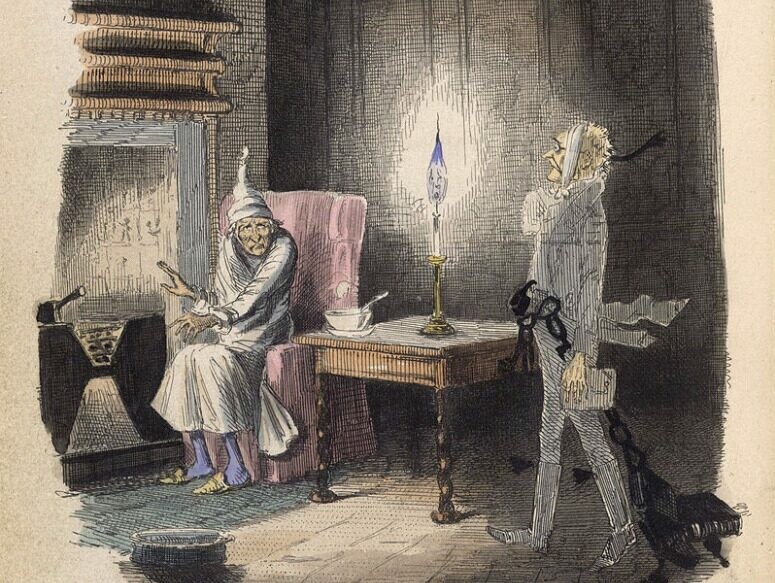
Yes, ghosts. Admittedly this part of the tradition has not been as popular as the lights and such, but there was a time that it was a part of the celebration of Christmas. Dickens was not coming entirely out of left field to have crafted his own Christmas ghost story. I learned recently that it was quite common for tales of ghosts to be told during the festivities. Of course, aside from Dickens this has seemed to fall out of fashion, likely in part to the rise of Halloween’s popularity. Or perhaps Dickens is not all that alone as there are now those for whom Tim Burton’s The Nightmare Before Christmas is a holiday classic, a blend of American concepts/traditions of the two holidays. I’ll even throw in here that It’s A Wonderful Life is something of a ghost story, or at least has some elements like one. Why this relationship though? What is the connection between the ghost story and Christmas? It’s something I’ve been thinking about recently and here I have some answers I have considered in order of what I see as most interesting/compelling.
The simplest, most obvious explanation. Ghosts are associated with Christmas because its dark and cold and that’s spooky.
The second explanation is th-
Eh, okay I’ll say a bit more.
Really the last thing that I want to do in writing this is to dismiss the sensations and thoughts we experience as unimportant. For that reason, I think it is worthwhile here to discuss what I’d say makes a ghost story. The ghost is, to my mind, perhaps the most basic horror/monster in the cultural cannon. It is basically the gateway to all other horrors. In one respect, the ghost is a manifestation of the simplest and most obvious horror of our existence, death and what follows. Other monsters have some additional complexity of meaning (e.g. the werewolf being the manifestation of the horrors of the beast within oneself). Ghosts tend to more simply confront the fears of death and the afterlife. The other way in which ghosts are entries to all horror is how they have come to be symbolic of the line between the natural and supernatural, between belief and skepticism. The ghost story of today is that which leaves open the question of its own reality. These stories often leave the reader in doubt as to whether the horror was real or imagined. It is never made clear. Perhaps we could even say that Dickens’ Christmas Carol is not a proper ghost story as he makes it clear that the spirits are true, not a figment of imagination.
The dark is a place of such imagination. Even the most hardened sceptics, the most thoughtful of psychologists, and the most reddit of atheists will find their eyes creating phantom figures in the dark. None of us can help it. The dark, the cold, these are entrances to consider there to be more than what you can fully make out with your eyes. For those who celebrate Christmas in belief, we know that there really is more there.
The dark can remind us of the presence of the spiritual both by the route of fear and the unknown or through the way that loss of sight can help one to feel dissociated from the physical world. Losing sight of the physical helps us to try to focus on other things. This is my generous take on churches that turn the lights down during the service, that it can help you to draw inwardly to thoughts of the soul and the spirit. Times of darkness then are good times to be feeling like there is more to the world than what we can see, a truth that is processed via the ghost story.
Beyond the simple fact of the physical dark there is also the influence of the season on how we think and feel simply through tradition. Maybe it’s the tradition. I’m not exactly sure what to attribute the Christmas spirit to (“spirit” in the mood sense rather than the spooky ghost sense. If I was talking about spooky ghosts, I’m going to use the spooky Germanic term not the French one). Whether you consider it lights, or music, or family members, or the simple fact of holding a tradition. This may be enough to bring us into a state of reflection which allows us to pierce through the veil of everyday concerns to glimpse the spiritual world. I wouldn’t much expect Ebenezer Scrooge or George Bailey to be drawn into such a monumental shift in his perspective if it were just, I don’t know, Arbor Day or something. That Christmas is a day of note gives it some power to view things more clearly.
Now, I would be remiss if I was writing an article to you, dear reader, that is ostensibly about some kind of supernatural being or horror and simply psychologized it. Lets not speculate and say things like, “maybe, like, it’s a new year and so the ghost… is you!”
No.
Instead, let’s take the idea of ghosts seriously. Seriously as in, assume that ghosts are what they are said to be and not just a trick of the mind. Assume it’s actually a dead person. How can we think about ghosts with Christmas then? In that way I think we actually have one of the strongest cases to associate ghosts and Christmas.
Quickly, are ghosts real? I would say no. At least, not in the way typically described. I do believe there is some state of being in which souls have been separated from the body. I do think that in 1 Samuel 28, King Saul truly does call up the spirit of the prophet Samuel and speaks to him. This is however not a common occurrence, only happening due to God’s will/allowance. As the Bible says in Luke 16: 26: “And besides all this, between us and you a great chasm has been fixed, in order that those who would pass from here to you may not be able, and none may cross from there to us.”
So then, Christians should be confident that the spirits of the dead do not speak to us nor interact with us. Spiritual interactions people have experienced should be regarded as being something other than the souls of the dead. Even so, it is worthwhile to think of the dead at the season of Christmas. As mentioned before, Christmas is the end of the advent season, the end of the wait for Jesus’ arrival. Yet, advent is not just a time for us to look back at his fist coming. It is, like so many practices in the faithful life, a look backward and forward at the same time. In the season of advent we consider how we are waiting once again, just as the nation of Israel awaited the messiah.
This time, however, we await his coming along with the dead. I do not precisely know where the souls of the dead go to wait for the resurrection, but they are waiting. They are not crossing that great chasm in order to spook us or tell us how to keep the spirit of the season, but I think they are waiting for the chasm to be sealed up, and for them to be returned to life. So then, maybe that is why we should think of ghosts during the advent season. They too wait for him.
Apologies, reader, for publishing this when we are outside of that waiting time of advent. The darkness is receding and so the time to think on the specters of the past is, admittedly, out of season. So, if you would like to wait until advent comes around again before reading the rest of the article, that would be alright.
 Being Kindled
Leave a comment