
An artist is a kind of magician who can conjure phantoms, drawing sensible images of real things from dollops of paint, heaps of stone or any other inanimate material which, consecrated to his craft, becomes a medium for life. The greatest artists have even been able to go beyond this, imbuing the sensible images they summon with suggestions beyond the purely visible, comprehending untouchable Truth with malleable substances. Raphael’s iconic “School of Athens” is one such work. While a more seasoned aficionado might be capable of honing in on Raphael’s brilliant execution of anatomy, composition, and any other technical feat, it is sufficient for our purposes to note how succinctly and excellently Raphael manages to summarize the metaphysical differences between the painting’s two central figures.
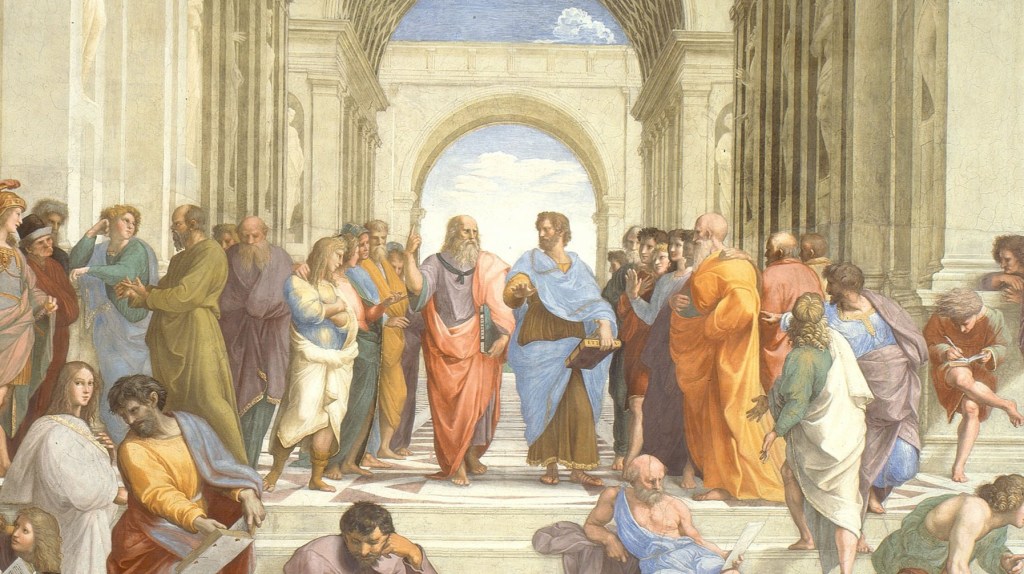
Plato staunchly directs his finger toward the patch of blue heavens above, the invisible arrow of his gesture landing in the likewise invisible “world of Forms.” Aristotle, meanwhile, amicably disagrees with an outstretched appeal to the far more perceptible world below, his contentious hand thrust toward the viewer. The two men are so close that their figures overlap in the scene, and there is doubtlessly a magnetic tension between their opposed metaphysical views. The sages differ on their view of the location of essence: Plato emphasizes its transcendence, Aristotle its imminence.
The irreconcilability of the two must be understood in their interdependence in a sort of dialectic sense. They are competitors, but not strictly opponents. For one, the depicted overlap between them is evident in their unity in essentialism. Both contend that things are actually what they are, that the categories to which they belong are real, that the names things are given are not hollow signifiers but descriptors of reality. They compete for the same prize. The disagreement in their metaphysics basically lies in the location of essences. The tension, then, emerges from the two-headed fact that the world is immediate and also inaccessible. Real things can be felt, seen and tasted. Their characteristics describe their realness, but that realness of itself is invisible. They are like shadows cast on the wall of a cave, in Plato’s estimation. Something about reality — indeed, for Plato, the very foundation — eludes mere perception. Essences are simultaneously available and inaccessible.
Another great artist, Victor Hugo, personified this tension in the character of Dom Claude Frollo, the tormented archdeacon of Notre-Dame de Paris’ eponymous cathedral. Hugo’s masterpiece can be read (and I think rightly so) allegorically. Hugo’s primary concern, and the beating heart of the novel, is the medieval beauty of the cathedral herself — and by extension of Paris, and of France, and even of Europe. The great tragedy of the narrative is the defiling of her sanctuary, the transformation of the Church, as building and as institution, from a place of spiritual refuge to one of worldly desire. This transformation is ushered in and embodied by Frollo, the clergyman who cultivates knowledge instead of virtue, whose destruction is the quest for wisdom that invites desire.
Quasimodo casts off Frollo. The spirit of Notre Dame rejects him, vomits him up. The gothic sublimity of medieval Christendom cannot abide the unrepentant scientist. Her antique beauty is too fragile for the grip of a soul so possessive. The knowledge-lust of Frollo’s proud mind, and further of the spirit of scholastic intellectual conquest, brings itself and the beauty subjected to its perverse affection to ruin. Quasimodo and Esmeralda lie side-by-side in the grave, first wounded by Reformation, perhaps, and then killed by Enlightenment. The Medieval age collapses into the Modern at the hands of the alchemist who was supposed to be a priest.
The bulk of Hugo’s affection may have been for the architecture of medieval Christianity, but the allegorical capacity of his grim tragedy extends beyond monuments of stone, as Hugo is well aware that even such monuments extend beyond themselves. The tragedy of Notre-Dame de Paris is the tragedy of the whole Medieval era, that the pursuit of knowledge triumphed over the pursuit of holiness in the bowels of her institutions. Claude Frollo embodies the unsustainable contradiction of his time. He is a man as quick to denounce witchcraft as he is to practice alchemy. His lust is the same as his concealed paganism. La Esmeralda, his unholy muse, is the object of both his desire and his scorn. In mistaking his lust for love, Frollo evidences his confusion of enlightenment of the mind with enlivening of the soul.
Frollo is, as seems to be Hugo’s intent, very much a product of his time. The grandiosity of his religion is devoid of basic goodness. In his character, the pagan-tinged quest for alchemical power over the material world is wed unnaturally to catholic piety. The literally grotesque Quasimodo, the breath and voice and soul of the cathedral, indicts the pompous hypocrisy of his more learned masters by his sublime and simple charity veiled in melancholy humility.
Medieval Roman catholicism was characterized in large part by its grandiosity. The architecture of the day was merely symptomatic of this. While many secular authorities spent the Middle Ages coveting the throne of Europe vacated by the late Caesars, the pontiff of the Eternal City steadily crawled up the steps to that alluring dominion. It was the age of Christ’s alleged vicar on earth and thus very earthly in its focus. Identification of the Church’s visible institutions with her invisible Spirit grew in strength. The time seemed to many to have come where, indeed, one might say “Lo here! or, lo there!” as though the Kingdom of God had blossomed from “within” and sprouted into the visible world.
It should be plain to see, then, why this setting, replete with stained glass glistening like the crystal sea, bountiful incense, manuscripts illuminated with gold and pigment, a world filled with light and color as Heaven itself, intoxicated the scholastics with a fervor to conquer the frontiers of ignorance. It was the era of cumbersome tomes, heady debates, holy academics, prestigious universities, and consequently, the revival of Aristotle.
Even Dante could not send the virtuous pagan sages of classical antiquity any lower than the uppermost of Hell. Aristotle found such favor among the paragons of Medieval thought that he became known simply as “the Philosopher,” as if to suggest philosophy had found in him its very end. The general sentiment of his metaphysical contrast against Plato is evident in the disposition of the Church which venerated him. The earthly Christendom, the world of God’s Kingdom on earth, the spiritual realm fully embodied, the “vicar of Christ on earth,” found its basic elements in Aristotle. Aristotle imagined the invisible essence of things to be fully present in those things. The medieval magisterium of Rome identified the invisible Spirit of God’s people fully with the organization to which those people belonged, identified the ascended Christ with the very-much-still-grounded pontifex maximus.
The flow of divinity had been reversed. The body of Christ became the head. Aristotle’s metaphysics informed a new understanding of transubstantiation, bringing the spiritual realities of the Eucharist so low as to overlap with their material embodiments with unprecedented specificity. Christ no longer descended to raise up his Church, but rather the Church ascended to Heaven on the wings of magisterial ceremony to retrieve Christ and distribute Him according to its own whims. When the will of the Spirit and the will of the magisterium became one, the latter usurped the former. Their trajectories in the Medieval mind brought them slipping past one another.
It is perhaps little coincidence that Marian devotion flourished in this environment. She who is blessed among women, who so faithfully embodied all God’s people to whom He was born and came to save, personification of the Bride, became adored far beyond her due. The visible world shaped the invisible to its image. The cosmological hierarchy to which even the sexes appeal was inverted.
Thus, this ecosystem of Christianity collapsed in a Babel-esque manner. As the Church sought enlightenment, harnessing its material reserves to erect unthinkably magnificent towers and its intellectual powers to build equally magnificent systematic doctrine, God scattered their language. Out of the mouths of a thousand donkeys came a chorus of rebukes in vulgar tongues against the Roman Balaam, who knew no other but to keep striking violently. The Latin that built Roman Babel was disintegrated by German, French, and English Scripture, theology, liturgy and thought.
It should be little wonder that the Medieval age became the Modern. As the tower grew, the foundation of Christ’s essential love was eroded by neglect. The faith which should supplant sight evaporated. The church became Rome, and like Nero it put Christians to the sword. She came to value correctness over charity, Truth over Goodness, Beauty over Truth, and the intellectual, dogmatic sanctity of her body over the commandment against murder. She preferred to have blood on her hands than to have incomplete dominion.
Where was the Philosopher to be found in all this? His triumph in that era was that of imminence over transcendence. The coveted quintessence of Medieval alchemy, the elusive “Philosopher’s Stone,” was not some metaphor for virtue or godliness, but an imagined material power over the very fabric of creation, a physical prize whose chief end was the infinite multiplication of treasure on earth. Just as the function of the Eucharist was the physical transformation of bread and wine into flesh and blood by Latin incantation from the holy (magical) lips of a consecrated mortal — a mere material transposition — the function of alchemy was the appropriation of transmutative powers to the rest of the material world. If bread can be flesh, lead can be gold. The invisible Forms are near enough to grasp.
Aristotle’s metaphysics, explicating the accidental nature of attributes, enabled this shamanic atmosphere in which the supernatural could be touched. Aristotle eradicated the Forms as a separate (holy) world, and so the diaspora of essences displaced by this eradication necessarily trickled down into the material world. The Kingdom of God became thought of as visible.
As a counterexample, to apply Plato’s metaphysics to ecclesiology would be to view the Kingdom of God as the invisible, transcendent Form in which the Church imperfectly participates. Plato lifts the invisible back to where it belongs: out of man’s grasping hands and far from his groping intellect. Raphael’s Aristotle points our eyes down at ourselves, while his Plato points us to God. (I would put forward as well that a platonic view of the Eucharist as an incomplete participation in the perfect to which it appeals is more sensible.)

Frollo sees himself in a spider’s web. He sees the sun only through a window, he sees the alchemical power he loves in a mirror, dimly. La Esmeralda is unattainable. No amount of will or knowledge can make him loved. His desire for her is not only itself unfulfillable, but renders his spiritual vocation the same. In desiring all, he loses all. He strives after what the eyes of his flesh can see, but knows that the glass of the window keeps it from him. He is tormented by the inescapable “vanity of science.” Eternity is in his heart, but the world is withheld from him.
Great art has a richness and density of truth that mere explanation lacks. The walking poem of Claude Frollo does not cast doubt on the metaphysical designs of Aristotle in abstract, but in history. Aristotle is not an idea, after all, but a man. His ideas do not arrive on the wind or in the clutches of some magic force divorced from time, but they ripple through the whirling pages of history, its actors like letters scribed thereon in flesh and blood. So, while the particulars of Aristotle and Plato are worth attention, it remains my conviction that they cannot be contrasted in the abstract without the context of historic reality.
It may seem unorthodox to begin an appraisal and critique of Aristotle with an examination of Victor Hugo, but perhaps after sufficient aesthetic consideration, a more philosophic assessment of the topic can be given with greater acuity.
And if any man think that he knoweth any thing, he knoweth nothing yet as he ought to know. But if any man love God, the same is known of him. — 1 Corinthians 8:2-3 (KJV)
And when he was demanded of the Pharisees, when the kingdom of God should come, he answered them and said, The kingdom of God cometh not with observation: Neither shall they say, Lo here! or, lo there! for, behold, the kingdom of God is within you. — Luke 17:20-21 (KJV)

 Being Kindled
Leave a comment