
They say travel broadens the mind; but you must have the mind.
— G. K. Chesterton
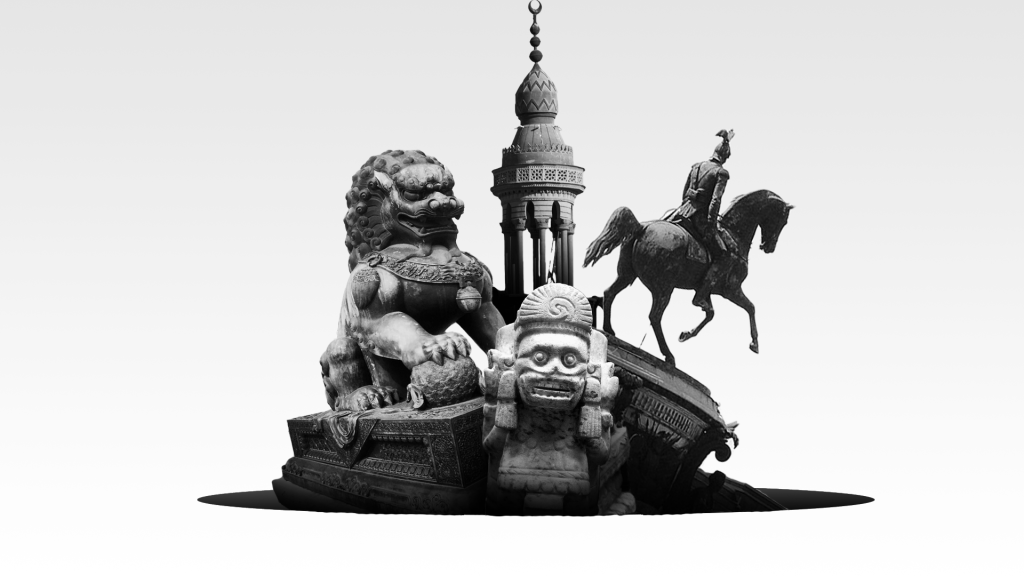
Multiculturalism is actually less multicultural than whatever we might call the alternative. Where once Americans were promised a “melting pot” in which new cultures contributed to the zeitgeist while being absorbed into it, the liberal cultural powers-that-be have accepted a new metaphor of a “salad bowl” in which many cultures exist autonomously side-by-side. But multiculturalism is a melting pot. The salad bowl is just how countries work.
Borders, though now understood primarily through their relationship to the state, were once merely the geographic instantiation of linguistic, ethnic, and cultural distinctions. The boundaries that make cultures exclusive are the same boundaries that define them. Cross-cultural relationships that erode boundaries and exclusions actually erode cultural definitions, leading to the fetishization and reduction of individual cultures to their least offensive aesthetic properties such as food, dress and music. Multiculturalism is, basically, liberal imperialism. This species of imperialism does not subsist on a diet of natural resources or lands but rather of cultures themselves, subsuming their structures of value and disintegrating all but the shallowest signifiers of diversity.
This is why explorations of other cultures in the liberal atmosphere so often fail to dig any deeper than consumer-oriented, market-tested gimmicks. Take, for example, what springs to mind at the thought of “Chinese culture.” The phrase probably conjures, for the average Westerner, images like red and gold, a certain exotic pagoda-esque geometry, paper lanterns, straight vertical collars and chopsticks more than it does Taoism, Confucianism, ancestor worship or wuxing. Multicultural participation is always, in this climate, colored by cold, dispassionate secular sterility. The gods and monsters of pagan myths are quaint curiosities. A dish with exotic spices or obscure vegetables or a folk costume with scintillating strangeness suffices for the liberal (or neo-liberal, if you like) purveyor of alien cultures. Any understanding of the values, knowledge or worldview of said cultures is contrary to the exercise, in part because admitting fissures in these areas is essentially indigestion to the liberal machine.
I read an article recently about an openly homosexual imam somewhere in the Mohammedan world — which is, admittedly, quite a sordid sentence all-round. Regardless of whether this imam himself could be described as a liberal imperialist, the author of the article certainly was. The piece presented this imam as a sort of martyr, a patron saint of secular self-identity in the Rome of religious dogma. It applied without any irony the language and categories of liberal intersectional self-realization to this imam’s situation, waxing poetic about his “true self” and the usual postmodern romantic rigamarole. This is the conquest of liberalism in the West today. Foreign cultures are the territory to be won and presumptuousness is often the weapon.
What I mean by this is that liberal imperialism asserts its control by asserting the preexistence of its control. It conquers by claiming inevitability and invariability for its core principles. “Of course,” it posits triumphantly, “An imam in the Middle East thinks of himself in the same terms as a Western liberal, and naturally so do his oppressors.” This is a sort of casus belli, a declaration that the territory already does and always has belonged to the sovereignty of its cause. Just as Adolf Hitler justified invasion of neighboring territories by appealing to their German roots and language, liberal imperialism puts on a shoddy sock-puppet fetish of a foreign entity and mimes a confession of liberal principles. The language of Western postmodernism is put in their mouths and the faux linguistic parity is touted as vindication.
This sham is seen to fall apart in cases like the Midwestern town that elected an all-Muslim city council and suddenly had pride flags banned in public. The real-deal adherents of sharia don’t resemble the sock puppet very closely. The diversity-loving liberals of the West can pretend all they like that peoples and cultures and religions are all basically the same, until a religion contravenes multiculturalism itself. Islam in particular is no stranger to good ol’ fashioned imperialism of the much bloodier sort, and in cases like the aforementioned it is clear that Islam has not been tamed quite as thoroughly in some parts as the liberal empire might have hoped.
The liberal empire needs Islam to be an aesthetic and nothing more, to consist in quirky, marketable habits and exoticized consumables rather than in claims about the metaphysical and the moral. Just as the Greeks and Romans considered those who did not speak their languages “barbarians,” the borders of liberal citizenship are defined by fluency in the propositions of liberalism as a mode of thought, submission of all other facets of worldview to the “emperor,” the dominant notion that no notion can be dominant — except itself, paradoxically. It is the paradigm of ironic tolerance at play all over the West today.
The liberal order cannot function as a “salad bowl.” The whole point of having national borders is to delineate between cultural, linguistic, and governmental entities. Carving up a nation into many little nations was the intent of the founders of the United States, but the Union was predicated on acceptance of certain propositions beyond mere tolerance. It was Christian religious tolerance specifically that held the disparate cultures together. Protestantism is fractious, to be sure, but having a common confession of Jesus as the Christ, the Son of the living God is nothing to sneeze at. It’s metaphysically a lot more than secular liberalism has going for it in terms of a propositional adhesive.
There’s an essential dialectic tension between commonality and diversity that Protestantism — even, I would suggest, above the more ecclesialist Christian traditions — maintains quite well by design. Protestantism embodies very closely the Pauline paradox of one body with many members. But this state is, nonetheless, a tension, and when that tension snaps and releases its energy, it spirals into either the impossible homogeneity of dogmatic legalism or the equally impossible nonsense of liberalism in which we now live.
Returning to the original thesis, liberal multiculturalism, in distinction to Protestant religious liberty, does not demonstrate adequate respect for essential differences. I had a conversation recently in which this difference of respect was made comically apparent. My interlocutor, a non-religious spiritualist, contended at once that no one religion can be correct, that they are all fundamentally the same, but also that the interdenominational differences of Christianity make its proposed faith not worth pursuing. I was struck by how very nearly these propositions are perfectly backward. The competing claims of various faiths make them all fundamentally different and mutually exclusive, but the common worship of Jesus Christ makes the differences of Christian practices worth overcoming, when at all possible.
So, the liberal attitude makes differences both null and insurmountable, which is really to say invisible. Untethered from the epistemic anchor of any faith claim, the non-religious spiritualist is completely unwilling and unable to actually accomplish the work of cultural unity. The denial of essential cultural differences does not eliminate them. They are objective facts of human society.
As is typical of the Marxian iconoclasm of secular post-modernism, the erasure of all distinctions does not actually turn the world into a grey nothingburger, it merely turns our perception of the world to such. Some lines are just too dark to be erased. The line-blurring ethos of deconstructionism doesn’t change the world and make it more navigable, it changes our orientation and makes the world harder to see. Rubbing the eraser on our eyes isn’t going to help redraw the map.
I don’t wish to weigh in too much on the issue of immigration, but it is an obvious battleground of this philosophy. While some may believe themselves to want more Hispanic foreigners welcomed in the United States because of the depth of their own tender compassion for the sojourner, the fact remains that many in the same camp do not wish to help the sojourner but to eliminate the category entirely, openly decrying borders as inherently evil. At a certain level, that claim is plainly irrelevant, given that no actionable solution appears tenable in the slightest. If we grant that borders are evil, then they are a necessary one, it seems. The influx of migrants from Latin America into Anglo America will result in both parties changing, either in culture or in borders. Liberal multiculturalism cannot simultaneously peacefully integrate two groups and maintain stark distinctions between them. Foreign cultures cannot be both possessed and preserved, celebrated and untouched. The map of the Americas is already a salad bowl, and the salad has merely been tossed.
The basic problem is that people, while essentially all “one,” are also essentially individuals, and the nesting of tribal categories is natural and even good. Peoples speak different languages, and different languages represent different schemes of thought. This is a higher-order embodiment of the fact of individual consciousness. Basically, people see the world differently, and this fact has drastic implications for how peoples act out their isolated worlds in the objective world we must share. To assert that all people basically see the world the same way — which is the essence of the asinine suggestion that all cultures are basically the same — is stupid, naive, and dangerous. If one saw all physical objects as essentially the same and oriented one’s actions accordingly such that, for example, one felt safe eating wood screws or drinking antifreeze, such an individual would not live for long. We should not think that societies, which are, if I may remind us, made out of people, will fare any different.
The fact is, people are not just separate arbitrarily but because they really are different. Borders are good because they inform us of those differences and how to navigate them. But, this can only be the case in the presence of a central, binding, encompassing, ruling, orienting principle. The Christian framework, notably, predicates even the essence of humanity upon the essence of divinity. It is not sufficient to simply observe that “we are all human” and then sing Kumbaya or whatever the unwashed shamanoids do nowadays. Without a transcendent vision of humanity, we cannot even know what it means to be human, and without the person and work of Jesus Christ upon the cross, we cannot even attain to that vision, anyway.
When the Apostle Paul writes that in Christ there is no Jew nor Greek, man nor woman, slave nor free, he is clearly not saying that these distinctions do not exist, else he would not bother giving specific commands to men, women, slaves and freemen respectively. Rather, the suggestion is that Christ transcends the distinctions. Jesus does not abolish the law, but fulfills it. He does not erase the essence of being human, but raises it up to fulfill the imago dei. Christ, after all, ascends bodily to Heaven. He Himself does not cease being human in Paradise.
So, the question remains: do we want a salad bowl or a melting pot? Though the dressing might get spread around a little more evenly as it’s tossed and rearranged, a salad still lacks a medium through which to be melted into a unified whole. Personally, I don’t want a melting pot coalescing around anything less than Christ and Him crucified. Let that confession be the broth, if you like. The Kingdom of God and its righteousness are far preferable to the empire of liberalism and its tolerance. Respect for differences and faith in common must go hand-in-hand. Differences must be transcended, not eradicated. They must find their purpose in Christ rather than their destruction. Thankfully, earthly success in this endeavor across cultures is negotiable, only because its success in Heaven is assured. We should not ignore or exacerbate the pains of cross-cultural conflict, but instead let those pains turn to longing for the unity to be consummated at Christ’s return.
For ye are all the children of God by faith in Christ Jesus. For as many of you as have been baptized into Christ have put on Christ. There is neither Jew nor Greek, there is neither bond nor free, there is neither male nor female: for ye are all one in Christ Jesus. — Galatians 3:26-28 (KJV)
And they sung a new song, saying, Thou art worthy to take the book, and to open the seals thereof: for thou wast slain, and hast redeemed us to God by thy blood out of every kindred, and tongue, and people, and nation; And hast made us unto our God kings and priests: and we shall reign on the earth. — Revelation 5:9-10 (KJV)
For as we have many members in one body, and all members have not the same office: So we, being many, are one body in Christ, and every one members one of another. — Romans 12:4-5 (KJV)
 Being Kindled
Leave a comment